
Sweeping VRP vs Commercial VRP: which is right for your business?
Variable Recurring Payments come in two distinct forms in the UK, and they serve very different purposes. Sweeping VRP moves money between a customer's own accounts. Commercial VRP enables businesses to collect from customers. Both use the same open banking infrastructure, but the eligibility and use cases differ. Understanding that distinction is the starting point for any business evaluating VRP adoption in 2026.
What are Variable Recurring Payments?
Variable Recurring Payments (VRP) allow a payer to authorise a series of future payments from their bank account under a single standing consent. Unlike Direct Debit, the consent is held digitally at the bank, payments execute via Faster Payments in real time, and the customer retains full control: they can view, amend, or cancel the consent directly through their banking app.
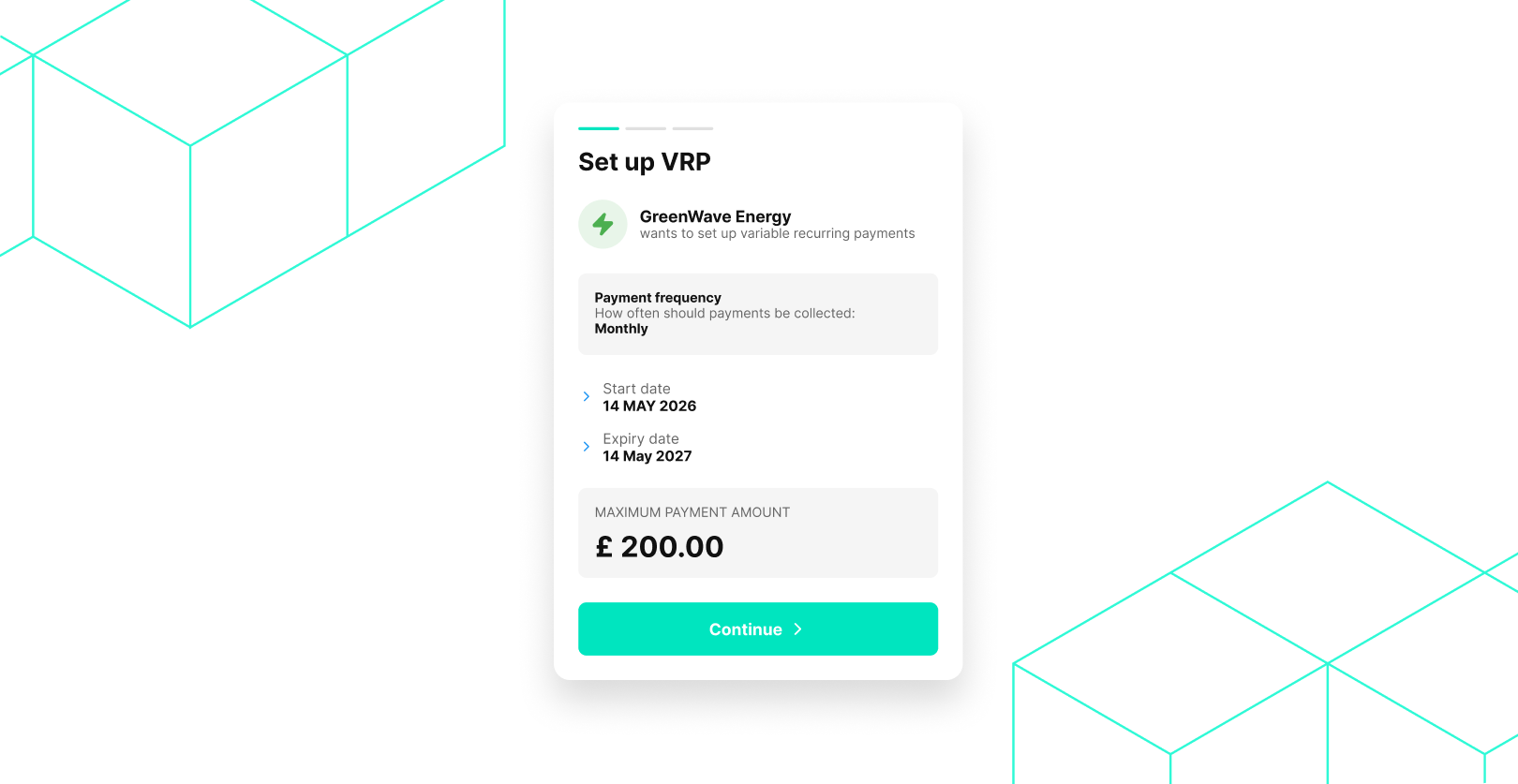
The customer sets up the consent once, defining a maximum amount, a frequency, and a duration. From that point, payments execute automatically within those agreed parameters without requiring re-authorisation for each individual transaction.
There are two types of VRP emerging in the UK: Sweeping VRP and Commercial VRP. They share the same underlying infrastructure but cover different use cases.
Sweeping VRP: me-to-me payments
Sweeping VRP typically moves funds between two accounts held by the same person.
Common use cases include automatic top-ups from a current account to a savings account when the balance drops below a threshold, moving funds between accounts held at different banks, and automated debt repayment sweeps where a customer instructs their bank to sweep surplus funds towards a loan balance at the end of each month.
Sweeping VRP (sVRP) has been live in the UK since 2022 and for businesses in lending and wage advance, it is already a practical tool used by many. A borrower can also authorise a sweep from their existing current account to meet a repayment obligation. Modulr is live with customers with Sweeping VRP for this use case today. Discover how we support Lending and Wage Advance businesses with their payments.
Commercial VRP: me-to-them payments
Commercial VRP (cVRP) enables payments from a customer's account to a third party: a business, a charity, or a government body. This is a newer capability, and the one with the broader commercial potential.
Under a cVRP consent, a business can collect variable amounts from a customer's account under a single authorisation. The customer does not need to re-consent for each payment, provided the transaction falls within the agreed parameters. Settlement is instant via Faster Payments.
For businesses running high-volume recurring collections, this changes the economics of the collections cycle in three ways. There is no three-day settlement wait. Funds availability is checked before the payment executes, which reduces failures from insufficient funds. Variable amounts within agreed limits can be collected without manual adjustment or re-consent, which removes the operational overhead of managing amount changes in Direct Debit.
Commercial VRP: where it's expected to apply first
As Commercial VRP rolls out in the UK, initial coverage is expected to focus on a defined set of sector categories where recurring, variable-value collections are common. Based on industry direction, the categories likely to be in scope first include:
- Energy, utilities, and telecoms: variable monthly bills and consumption-based charges
- Regulated financial products: stocks and shares ISAs, mortgage repayments, and pension contributions
- E-money institutions: variable payments and adjustable savings flows
- Local and central government: council tax, fines, and resident payment plans
- Registered charities: recurring donations
At launch, Commercial VRP is expected to be limited to categories in this initial scope. Businesses outside these areas are unlikely to be able to use cVRP as a collection method at launch, but the scope is expected to broaden over time, with property becoming a strong candidate for inclusion in a later phase.
How to think about adoption timing
Organisations in sectors expected to be in initial scope can begin preparing Commercial VRP into their collections roadmap now. Replacing Direct Debit immediately is not necessary. cVRP works effectively as a complement, handling the portion of the collection book where variable amounts and instant settlement add the most value.
Modulr's Collections Hub is being designed to support a hybrid approach: cVRP where bank coverage and customer consent are established, Direct Debit as the fallback. As more banks enable cVRP, the proportion executing via the faster rail can grow without re-integration.
For businesses outside the categories expected to be in initial scope, such as those in lending, Sweeping VRP remains the appropriate tool for account-to-account and repayment use cases. The strategic position is to continue developing those capabilities now, so that when the scope broadens, the commercial and operational infrastructure is already in place.
Modulr supports a full range of collection methods, including Direct Debit and Open Banking payments today, with Commercial VRP to follow. Explore Modulr's pay-ins and collections solutions.
Disclaimer: This article is for informational purposes only and should not be construed as financial, legal, or regulatory advice.
TL;DR
Sweeping VRP moves funds between a customer's own accounts and has been live in the UK since 2022. Commercial VRP enables businesses to collect from customers under a standing consent, with instant settlement via Faster Payments and no re-authorisation required per transaction. Initial scope is expected to focus on utilities, telecoms, regulated financial services, e-money institutions, government, and registered charities, with broader commercial sectors anticipated in later phases.
FAQs
What is the difference between Sweeping VRP and Commercial VRP?
Sweeping VRP moves money between two accounts owned by the same person, a me-to-me payment used for savings sweeps, account top-ups, and loan repayment transfers. Commercial VRP enables a business to collect variable amounts from a customer's bank account under a single standing consent, a me-to-them payment used for recurring billing, subscriptions, and donations.
Is Commercial VRP available to all businesses in the UK?
No. The anticipated initial categories of eligibility cover five sector groups: energy, utilities, and telecoms; regulated financial services; e-money institutions; local and central government; and registered charities. Businesses outside these categories cannot yet initiate cVRP collections under current scheme rules, with further categories expected to follow as the market expands.
Does Commercial VRP replace Direct Debit
Commercial VRP is designed to complement Direct Debit, not replace it immediately. At initial launch, bank coverage is not universal, so most businesses will run a hybrid collection book: cVRP where consent and coverage are established, Direct Debit as the fallback. The proportion executing via cVRP grows over time as bank coverage expands, without requiring re-integration.
How does a Commercial VRP consent work for customers?
The customer sets up a consent once, defining a maximum payment amount, a frequency, and a duration. They authenticate using their bank's standard security method with face ID, fingerprint, or PIN. From that point, payments execute automatically within those parameters. The customer can view, amend, or cancel the consent at any time through their banking app.
How is Commercial VRP governed and who decides which sectors are eligible?
Commercial VRP in the UK is governed by an industry-led scheme that defines which sectors are eligible in the initial phase, sets consent and dispute management rules, and manages the process for adding new use case categories over time. Modulr is engaged with the scheme's development and has early visibility of eligibility updates as the market grows.
