
Commercial VRP for telecoms: a solution for consumption-based billing
Telecoms providers running large-scale Direct Debit programmes face a specific version of the collections problem. Billing amounts vary month to month. Installation charges, equipment costs, usage overage, and plan changes all create variability that a fixed Direct Debit mandate handles imperfectly. And when billing amounts spike, payment failures tend to follow. Commercial VRP (variable recurring payment), which entered the UK market under the UK Payments Initiative (UKPI) Wave 1 scheme in June 2026, is built precisely for this use case. This article covers what cVRP means for telecoms collections and where the practical starting points are.
The telecoms billing problem
Most telecoms subscribers pay a broadly predictable monthly amount: a plan charge, sometimes combined with a device repayment or a bundled service fee. But the billing reality is more variable than the plan headline suggests. New customers in their first month may owe an installation or activation charge on top of their first pro-rata bill. Customers upgrading devices mid-cycle trigger a change to the repayment amount. Customers exceeding their data or call allowances incur usage charges. Customers adding services or family lines change their total monthly commitment.
Each of these scenarios creates a billing amount that differs from the previous month. Under Direct Debit, this means either maintaining a fixed mandate and issuing credit or debit adjustments or updating the mandate amount and managing the notification and re-authorisation process. At 100,000 monthly Direct Debits, even a five per cent variation rate creates thousands of manual or semi-automated adjustment events per billing cycle.
How peak-month failures compound the problem
Failure rates in telecoms Direct Debit portfolios are not evenly distributed. They cluster around two events: first-month billing, where new customers may not have anticipated the full first-invoice amount, and upgrade or mid-contract change events, where an unanticipated billing spike coincides with a customer's normal payment date before they have adjusted their budgeting.
Each payment failure generates a recovery workflow: identify the reason code, determine whether re-presentation is appropriate, chase the customer, and manage the account through to resolution. UK Direct Debit failure rates are running at 2.44% on a seasonally adjusted basis (Pay.UK and ONS, February 2026). For a provider running 500,000 monthly Direct Debits, that creates approximately 12,000 recovery events per billing cycle. Each requires reason code assessment, a re-presentation decision, customer outreach, and account reconciliation. The operational cost model across processing, staff time, working capital, and churn grows in line with the subscriber base.
Where cVRP changes the equation
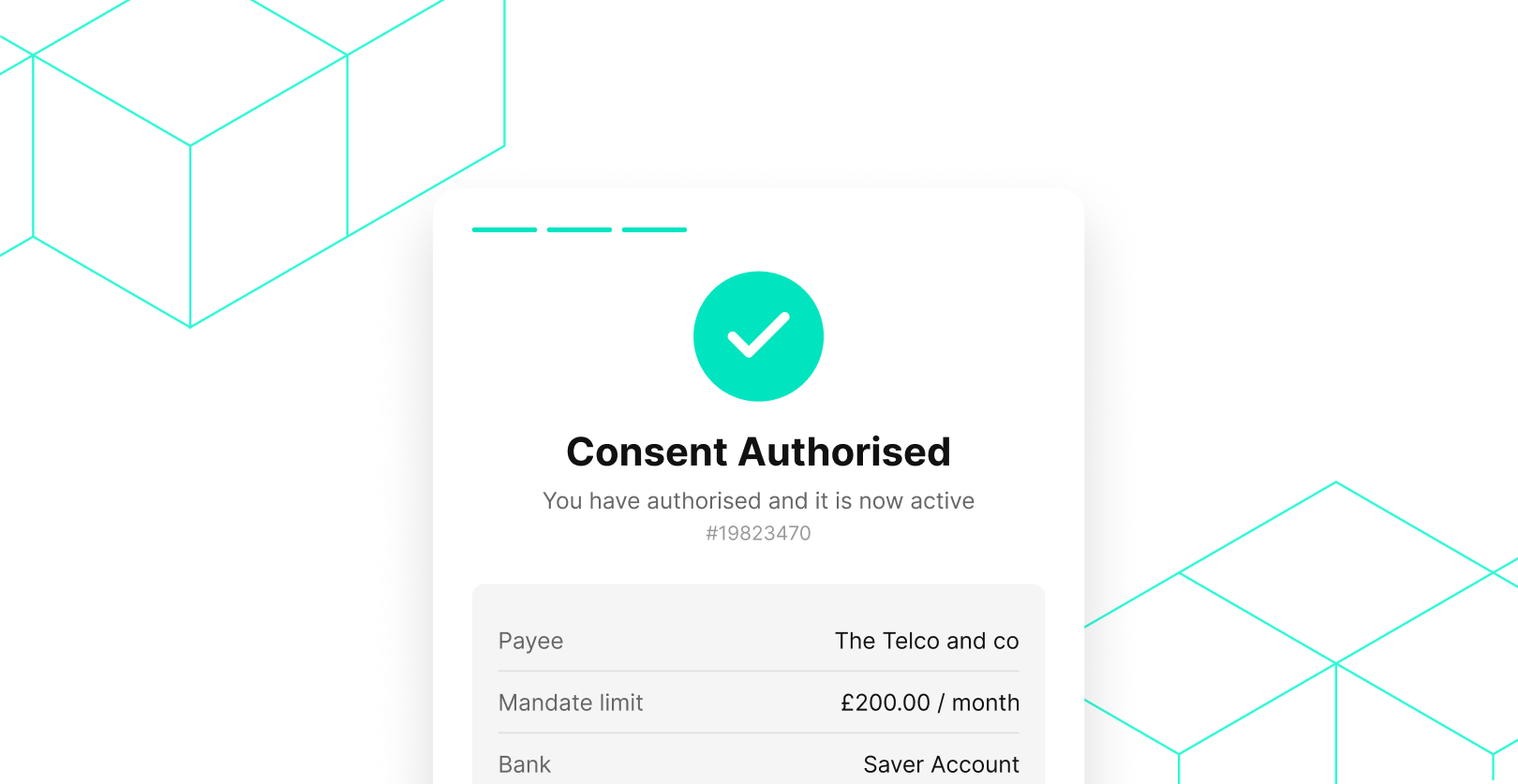
Commercial VRP does not eliminate billing variability. What it changes is how variability is handled at the payment layer. The customer authorises a consent once, defining a maximum amount and a frequency. The telecoms provider can then collect the actual amount owed each month within that ceiling, without issuing a new mandate or requesting re-authorisation. A mobile subscriber on a £45 plan who incurs a data overage charge might owe £63 one month and return to £45 the next. cVRP collects the correct amount each time without any change to the payment instruction.
cVRP checks funds availability before the payment executes. This removes the category of failures that concentrate in telecoms billing (first-month installation fees, mid-cycle device upgrade charges, and data overage spikes), where an unanticipated amount catches a subscriber with insufficient funds at the point of collection. If the account cannot support the charge, the payment does not proceed and the telecoms provider knows this in real time, enabling same-day recovery action rather than discovering the failure three days later through the Bacs reporting window.
Settlement is near real-time via Faster Payments. For a telecoms provider billing across a large subscriber base, moving from a three-day settlement cycle to same-day cash confirmation has a measurable effect on working capital, particularly during peak months when upgrade cycles and new subscriber acquisition create concentrated collection volumes.
As a complement to Direct Debit, cVRP addresses the high-value variable tail of the collection book: the consumption-based and upgrade-driven charges where billing amounts vary month to month. Direct Debit continues to handle the stable, predictable majority.
Positioning cVRP within the telecoms sales motion
The buyer persona for telecoms cVRP adoption is typically the Head of Finance Operations, the CFO, or in larger organisations, the Chief Revenue Officer accountable for billing and collections performance. The case is financial as much as operational: failure rates create cash flow exposure, recovery overhead grows with the subscriber base, and the cost of agent time managing adjustment events is increasingly visible in operational budgets as telecoms businesses scale.
The strongest entry point is Direct Debit failure rate data. If a provider can quantify the number of failures per billing cycle and the recovery cost per event, the business case for cVRP as a complement, handling the variable and high-value portion of the portfolio, can be constructed with a straightforward cost comparison. The additional value from near real-time settlement and a unified collections platform strengthens the case but does not need to lead it.
Our Collections Hub supports commercial VRP alongside Direct Debit and Open Banking for Wave 1 eligible telecoms providers. Find out more about Modulr's cVRP and Direct Debit hybrid solution for telecoms collections.
Disclaimer: This article is for informational purposes only and should not be construed as financial, legal, or regulatory advice.
TL;DR
Telecoms providers are Wave 1 eligible for commercial VRP under the UKPI scheme. The core use case is consumption-based and variable billing: data overages, mid-cycle device upgrades, and first-month installation fees all create amounts that a fixed Direct Debit mandate handles imperfectly. cVRP lets providers collect the exact amount owed each month under a single standing consent, without re-authorisation when amounts change. Funds are checked before collection, removing the failures that concentrate at peak billing events. Settlement is near real-time via Faster Payments, which improves working capital during upgrade and acquisition peaks. A hybrid approach alongside Direct Debit is the practical starting point, with the Collections Hub handling routing across both rails.
FAQs
Are telecoms providers eligible for commercial VRP under UKPI Wave 1?
Yes. Telecoms providers (including broadband, mobile, and bundled services providers) are explicitly included in the UKPI Wave 1 eligible sectors. The scheme launched in June 2026 and covers recurring collection from customer bank accounts for telecoms billing, with Modulr participating as a founding scheme member.
How does commercial VRP handle billing variability in telecoms?
The cVRP consent sets a maximum amount and frequency. Within those parameters, the provider collects the actual amount owed each month — whether a standard plan charge, an overage, or a first-month installation fee — without mandate changes or re-authorisation. Variability is managed at the consent ceiling, not the transaction level.
How does cVRP differ from sweeping VRP?
Sweeping VRP automates money movement between a customer's own accounts. Commercial VRP enables a third-party biller to collect the exact amount owed under a standing consent. For telecoms providers, this means collecting variable monthly charges — plan fees, overages, and device repayments — without the subscriber taking any action each billing cycle.
Can commercial VRP reduce Direct Debit failure rates in telecoms billing?
Yes. cVRP checks funds before the payment executes, removing failures triggered by unanticipated amounts — first-month fees, upgrade charges, and data overage spikes. Real-time failure notification compresses the recovery window from three-day Bacs reporting to immediate, enabling same-day recovery action and reducing failure management overhead.
Do telecoms providers need to replace their Direct Debit infrastructure?
No. A hybrid approach is the practical starting point. cVRP handles the variable, high-value portion of the collection book where the consent model and instant settlement add most value. Direct Debit covers the remainder as the fallback where cVRP bank coverage is not yet established.
What is the buyer case for cVRP in telecoms finance operations?
The financial case centres on three metrics: Direct Debit failure rates, recovery cost per event, and settlement timing. Reducing failures from the variable billing tail compresses recovery overhead. Instant settlement improves cash flow forecasting. A single Collections Hub covering all rails removes fragmented reconciliation and multiple provider relationships.
