
Commercial VRP Wave 1: a guide for eligible businesses
Commercial VRP launched in the UK in June 2026 under the UK Payments Initiative (UKPI) scheme. It gives businesses in eligible sectors the ability to collect variable amounts from customers' bank accounts under a single standing consent, with instant settlement via Faster Payments. This guide explains who is eligible under Wave 1, how it works for consumers and end users, and what businesses in scope should be doing now.
What Commercial VRP is and how it works
Commercial VRP (cVRP) is an account-to-account payment method that lets a business collect recurring and variable payments from a customer's bank account, authorised once under a standing consent. Unlike Direct Debit, settlement is instant via Faster Payments, funds availability is checked before each payment executes, and the customer controls their consent directly through their banking app.
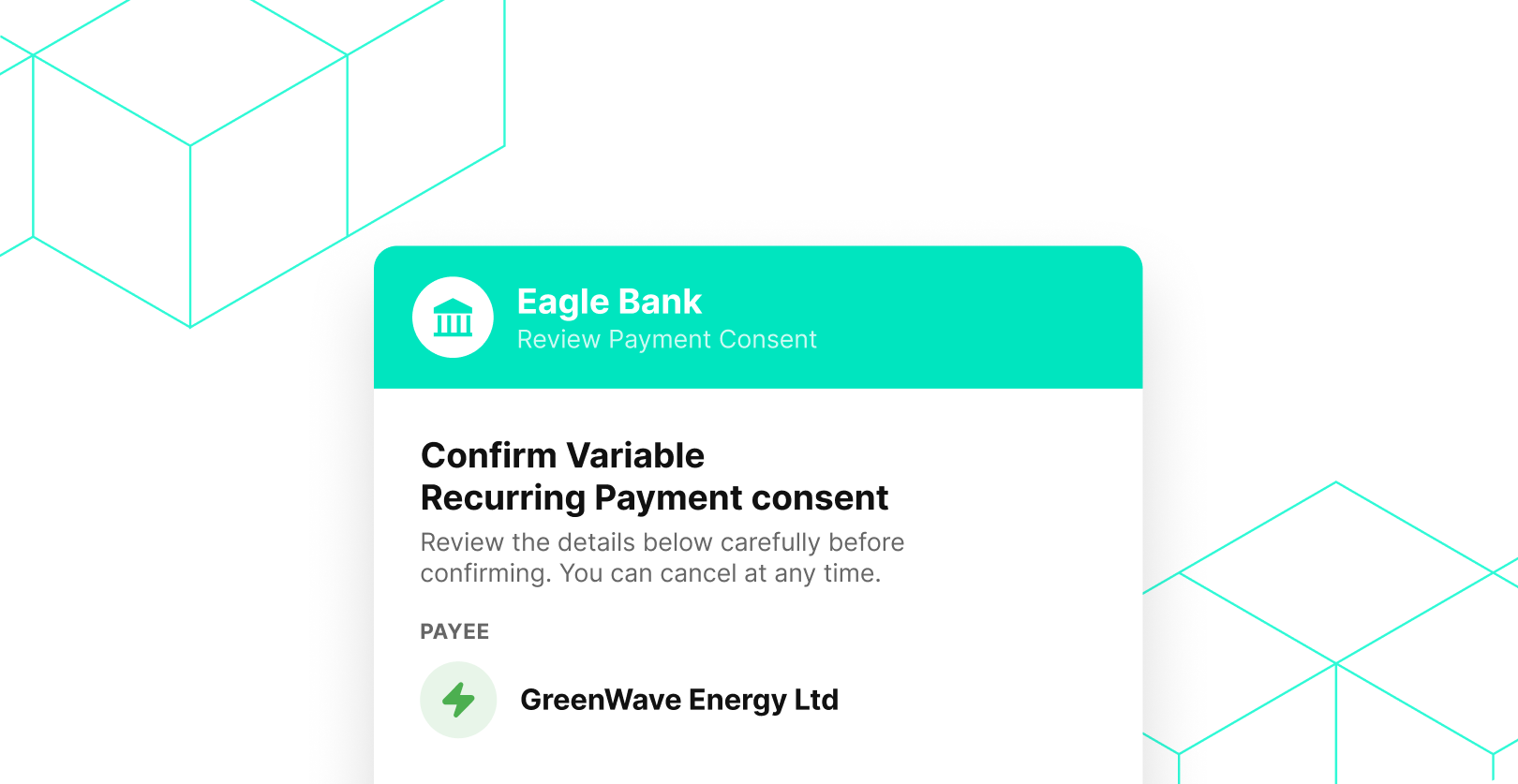
The customer sets up the consent once, defining a maximum payment amount, a frequency, and a duration. For example, up to £500 per month for 12 months. They authenticate using their bank's standard security method. From that point, the business can collect within those parameters without requiring re-authorisation for each transaction. The customer can view, amend, or cancel the consent at any time.
The key structural differences from Direct Debit are threefold. Settlement is instant, not three days. Funds are checked before the payment executes, reducing failures. The consent lives at the bank, not in a bureau file, which means the customer has direct visibility and control.
Wave 1 eligible sectors
The UKPI Wave 1 scheme is deliberately scoped to low risk sectors where the payment obligation is governed by a regulated or statutory framework. This provides the consumer protection structure the scheme relies on. There are five eligible categories.
Energy, utilities, and telecoms
This category includes residential and business energy suppliers, water companies, broadband and mobile providers. The core use case is variable monthly billing: cVRP collects the exact amount owed each month, removing the reliance on manual adjustment or customer re-consent when consumption varies. Seasonal volume spikes and the operational cost of managing Direct Debit failures make this one of the most commercially compelling Wave 1 sectors.
Regulated financial services
This category includes mortgage servicers, and pension administrators (specifically those authorised as master trusts by the Pensions Regulator). Commercial VRP can also fund FSCS-protected products such as cash ISAs. cVRP enables additional one-off payments alongside scheduled repayments and contributions, without requiring a new mandate for each variation. Existing Open Banking familiarity within this sector lowers the adoption barrier.
E-money institutions
This category includes providers of e-money accounts and digital wallets. Use cases include variable payments between family members, adjustable savings flows, and income-linked top-ups to financial wellness products. The real-time confirmation and customer-controlled consent model aligns well with digital-native product propositions.
Local and central government
This category includes council tax collection, fixed penalty notices, court fines, and resident payment plans. The value of cVRP here is the ability to time payments to residents' salary dates, reducing failures and the administrative overhead of manual recovery. Adoption is expected to be slower than commercial sectors, but the long-term volume opportunity is significant.
Registered charities
This category is for charities with significant recurring donation volumes, particularly those already operating digital giving programmes. cVRP removes the bank details friction of Direct Debit mandate sign-up, enables variable donation amounts without donor re-consent, and provides real-time confirmation of payment, addressing the multi-day settlement lag that complicates reconciliation for finance teams.
What is not in scope for Wave 1
E-commerce, buy now pay later (BNPL), unsecured loan repayments, travel supplier payments, and general commercial trade are all outside Wave 1 scope. These sectors are expected to gain eligibility in Wave 2, which is anticipated in the second half of 2026. Businesses in these sectors should continue developing their Sweeping VRP and Open Banking capabilities now, so that they are operationally ready when Wave 2 eligibility is confirmed.
Property and rent collection is not yet eligible under Wave 1, but Modulr is actively engaged in the UKPI Additional Use Case process to advocate for its inclusion. The Renters' Rights Act 2025 and its statutory payment framework create a strong structural case, and the outcome of that process will determine whether property platforms can adopt cVRP ahead of Wave 2.
What eligible businesses should do now
The first action for any Wave 1-eligible business is to assess which part of the collection book is best suited to cVRP adoption. The highest-value targets are high-volume variable billing flows where Direct Debit failure rates are material, and new customer relationships where the consent model can be built into onboarding from the start.
The second action is to evaluate integration readiness. Businesses that have already integrated Open Banking payment initiation are best placed to move quickly. Those still on bureau-based Direct Debit infrastructure will need to assess the integration pathway before the consent journey can go live.
The third action is to consider bank coverage. At Wave 1 launch, the UKPI scheme is targeting 75 per cent coverage of UK current accounts, covering the major high-street banks. A hybrid approach means businesses do not need to wait for universal coverage before starting: cVRP where coverage and consent are in place, with Direct Debit as the automatic fallback.
Modulr is a founding member of the UKPI scheme and supports Commercial VRP alongside Open Banking and Direct Debit collections. Explore our Pay-ins and collection solutions.
This article is for informational purposes only and should not be construed as financial, legal, or regulatory advice. Modulr is not a bank and is not covered by the Financial Services Compensation Scheme (FSCS); references to FSCS-protected products in this article refer to products offered by FSCS-authorised providers that may use Commercial VRP for collection.
TL;DR
UKPI Wave 1 opens Commercial VRP to five sectors: energy and utilities, telecoms, regulated financial services, e-money institutions, government, and registered charities. Businesses in these sectors can adopt cVRP now as a complement to Direct Debit, using a hybrid approach where cVRP handles the variable and high-value portion of the collection book and Direct Debit covers the remainder. Wave 2 is expected to broaden eligibility in H2 2026.
FAQs
What is the UKPI scheme and when did it launch?
The UK Payments Initiative (UKPI) is the industry-led scheme governing Commercial VRP in the UK. It launched Wave 1 on 2 June 2026, covering five eligible sector categories: energy, utilities, and telecoms; regulated financial services; e-money institutions; local and central government; and registered charities. Modulr is a founding member of the scheme.
Can my business use Commercial VRP if we are not in a Wave 1 sector?
No. Businesses outside the five Wave 1 categories cannot initiate Commercial VRP collections under the current UKPI scheme rules. Wave 2 eligibility is expected to expand scope to additional commercial sectors in the second half of 2026. Sweeping VRP remains available for relevant me-to-me use cases such as loan repayment transfers.
How much does it cost to set up Commercial VRP?
Pricing for Commercial VRP varies by provider. Speak to your provider about their commercial model for cVRP, Direct Debit, and Open Banking payments. Explore the full range of pay-ins and collections solutions, including cVRP, from Modulr.
How long does it take to integrate Commercial VRP?
Integration timelines depend on your existing infrastructure. Businesses already using the Modulr API for Open Banking can extend to cVRP with relatively low incremental integration effort. Businesses migrating from bureau-based Direct Debit infrastructure should factor in a longer runway (typically several weeks) to build the consent journey and test the end-to-end flow before going live.
What bank coverage does Commercial VRP have at launch?
The UKPI scheme is targeting 75 per cent coverage of UK current accounts at Wave 1 launch, covering the major high-street banks. Coverage will grow over time as additional ASPSPs (Account Servicing Payment Service Providers) become cVRP-enabled. A hybrid multi-rail approach means businesses can run cVRP and Direct Debit in parallel without waiting for universal coverage.
