
Commercial VRP for energy and utility companies: a collections guide
Energy suppliers, water companies, and other utility businesses have been among the first cohorts of businesses in the UK to gain access to commercial Variable Recurring Payments (cVRP). The UKPI Wave 1 scheme, which launched in June 2026, identifies utilities as a priority sector precisely because the collections problem here is well-documented. From variable monthly billing and seasonal demand spikes to Ofgem price cap adjustments and Direct Debit failure rates, all these factors generate operational overhead and cash flow risk at scale. This article covers what the Wave 1 rollout means for utilities businesses and where to start. For the full UKPI Wave 1 eligibility criteria and readiness checklist, read our guide.
Why utilities billing is a natural fit for commercial VRP
The core collections challenge in utilities is variability. A household's energy bill in January is not the same as in July. A water account's usage charge fluctuates with metering cycles. An energy supplier issuing a smart meter catch-up bill alongside the regular monthly charge faces a collection amount in that billing cycle that is materially different from months where no catch-up event applies. Direct Debit manages this through a fixed mandate supplemented by variable amount adjustments. The process works, but it creates friction when amounts change significantly and requires customer notification or re-consent in some cases.
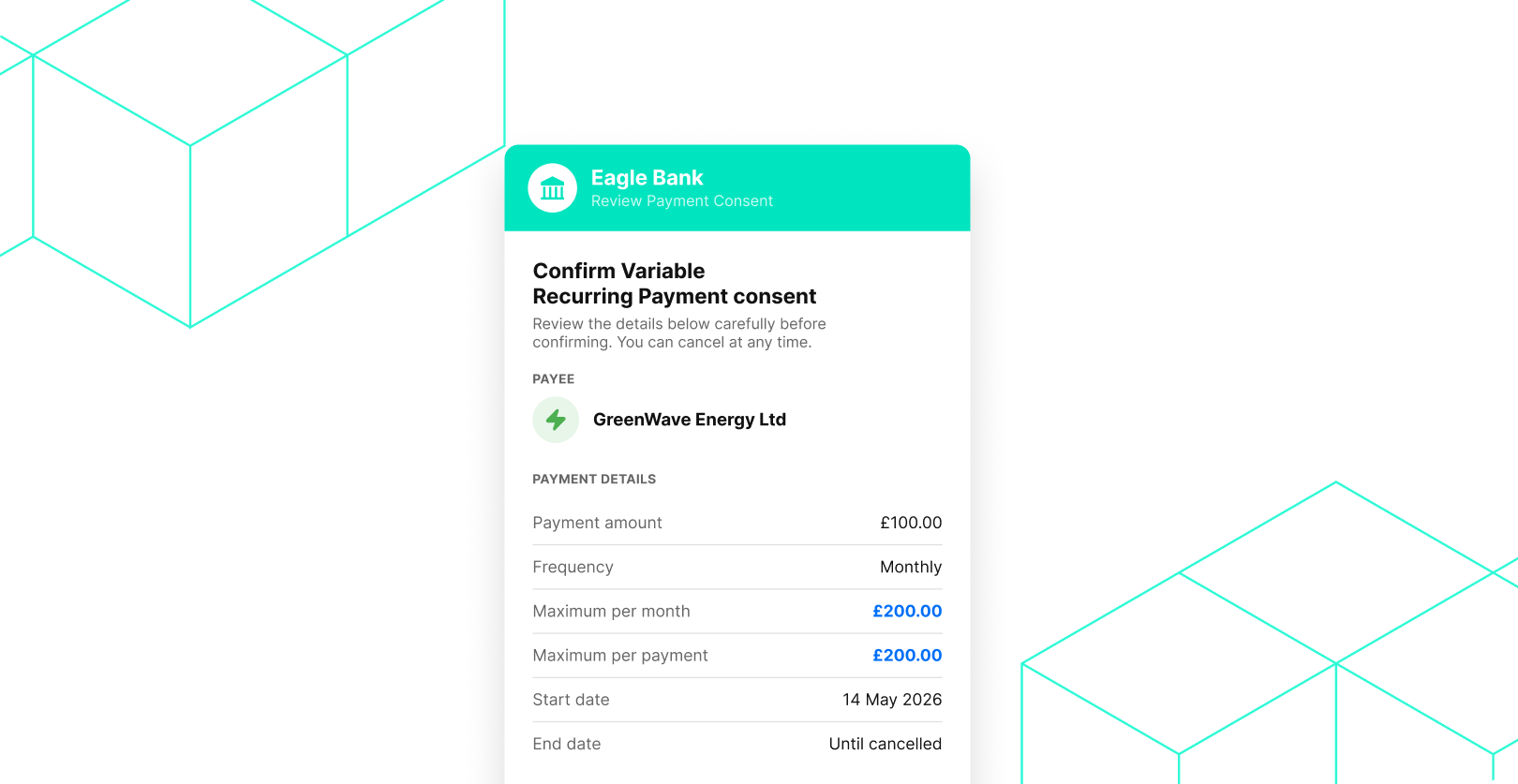
Commercial VRP allows the customer to authorise a maximum amount and frequency once. Within those parameters, the utility can collect the exact amount owed each month without requesting re-authorisation for every payment. For a household on a variable energy tariff, this means the payment is always accurate to the billing cycle, with no credit or debit adjustment to manage.
Settlement is instant via Faster Payments. For utilities running high-volume Direct Debit portfolios, the shift from a three-day settlement window to same-day cash confirmation materially improves working capital. For large suppliers processing millions of transactions per month, the aggregate effect on the cash position is significant.
Direct Debit failure rates in utilities: the operational cost
Direct Debit failure rates in utilities are not trivial. Insufficient funds, closed accounts, and cancelled mandates each generate a failure event that requires manual or semi-automated recovery. At scale, this creates a persistent reconciliation workload: identifying the failure reason, determining the appropriate recovery action, re-presenting where appropriate, and managing accounts that cannot be recovered in the short term.
Commercial VRP reduces failures at source by allowing businesses to check funds availability before the payment executes. This does not eliminate failures entirely (a customer with no funds will still not pay), but it removes the category of failures that occur when a payment attempts to execute against an account that could not clear it on that day. The business receives confirmation of payment success or failure in real time, rather than discovering the outcome three days later through the Bacs reporting cycle.
Faster failure visibility also compresses the recovery window. Rather than waiting for the ARUDD (Automated Return of Unpaid Direct Debits) reporting cycle to identify failed payments, a cVRP system can flag a non-execution immediately and initiate recovery logic the same day. Learn more about why large billers are adding cVRP alongside Direct Debit.
Consumption-based billing and seasonal demand
Utilities businesses face a compounding challenge in winter months: consumption spikes coincide with the period most likely to generate payment failures, because household cash flow is under pressure at the same time as energy bills are at their highest. Ofgem price cap adjustments — typically effective in April and October — compound this further: when the cap rises, monthly charges increase at the same point that seasonal consumption is climbing. A Direct Debit set to a fixed summer amount will under collect in winter. A Direct Debit adjusted upwards may require a new mandate that adds friction. Issuing credit and debit adjustments creates extra work for utilities, as well as uncertainty for consumers when trying to budget for an essential outgoing payment.
Commercial VRP handles consumption variability without this trade-off. The consent establishes a ceiling, not a fixed amount. As long as the monthly charge falls within the consented maximum, the payment executes without any action from the customer. Utilities businesses can set the consent ceiling at a level that covers peak winter consumption, collect the actual amount owed each month, and handle the variability operationally without involving the customer until the consent ceiling itself needs to change.
Building a hybrid collections approach
Most utilities businesses will not migrate their entire Direct Debit portfolio to cVRP on day one. Bank coverage at Wave 1 launch covers approximately 75 per cent of UK current accounts, and the practical approach is to run both rails in parallel: cVRP for customers whose banks are cVRP-enabled and who have established a consent, and Direct Debit for the remainder.
Over time, as more banks enable cVRP and as new customers are onboarded onto the cVRP consent journey from the start, the proportion of the portfolio on the faster rail grows. Modulr supports Direct Debit and cVRP collections for energy and utility businesses.
What to prioritise first
For utilities businesses starting their cVRP adoption, the highest-value initial targets are new customer onboarding journeys. cVRP removes the need to set up a Direct Debit mandate separately and requires no paper or email confirmation step. For utilities businesses with high-volume digital onboarding, this is a material improvement to the acquisition flow.
Modulr supports commercial VRP for eligible businesses, including utility and energy businesses. Explore our Pay-ins and collections solutions.
Disclaimer: This article is for informational purposes only and should not be construed as financial, legal, or regulatory advice.
TL;DR
Energy and utility companies are Wave 1 eligible for commercial VRP under the UKPI scheme that launched in June 2026. cVRP resolves the core collections challenge in utility businesses (variable monthly billing) by allowing them to collect the exact amount owed each month under a single standing consent, with instant settlement and real-time failure visibility. A hybrid approach alongside Direct Debit is the practical starting point, with automatic routing handling the transition as bank coverage grows.
FAQs
Are energy and utilities businesses eligible for commercial VRP under Wave 1?
Yes. Energy suppliers and water companies are among the businesses explicitly included in the UKPI Wave 1 eligible sectors. The core use case is variable monthly billing, where cVRP allows the business to collect the exact amount owed each month under a single customer consent without requiring re-authorisation when the amount changes.
How does cVRP handle seasonal billing variability in utilities?
The cVRP consent sets a maximum amount and frequency, not a fixed amount. Within those parameters, the utility can collect the actual charge each month without customer re-consent. A consent ceiling set to cover peak winter consumption means the payment is always accurate to the billing cycle, with no manual adjustment or re-consent process required when amounts vary.
Will commercial VRP reduce Direct Debit failure rates for utilities businesses?
cVRP checks funds availability before the payment executes, which eliminates the category of failures caused by insufficient funds at the point of collection. Real-time failure notification also compresses the recovery window: instead of waiting for the Bacs ARUDD cycle, a failed cVRP payment is visible immediately, enabling same-day recovery logic rather than a multi-day wait.
Do utilities businesses need to replace their Direct Debit infrastructure for cVRP?
No. A hybrid multi-rail approach is the practical starting point. At Wave 1 launch, bank coverage covers approximately 75 per cent of UK current accounts. Modulr supports utility businesses with their collections across Direct Debit, Faster Payments, and cVRP. Utility businesses can keep their existing Direct Debit collections running while adopting cVRP for the customers whose banks are Wave 1 enabled.
What is the integration effort for a utilities business adopting cVRP?
Integration effort depends on existing infrastructure. Businesses already using API-based Direct Debit or Open Banking can extend to cVRP with relatively low incremental work. Those on bureau-based Bacs submission workflows will need to build or adapt an API integration and a customer consent journey before going live. Modulr supports Direct Debit, Faster Payments, and cVRP for utilities collections.
