
The real cost of single-rail Direct Debit for lenders
If your collections model runs on a single Direct Debit rail, you are already absorbing a cost that most finance teams have not fully priced in. Not just the headline failure rate, but the operational drag that follows each failure: ARUDD reporting at day four, recovery decisions at day five, and the arrears position that deepens through every stage.
This article quantifies those costs, draws on published failure rate data, and sets out what a multi-rail model changes for lenders operating in consumer and SME lending, the segment where collections reliability has the most direct impact on the loan book.
Direct Debit failure rates are rising, and the numbers are documented
ONS data on monthly Direct Debit failure rates shows the failure rate for loans stood at 5.41% as at end of March 2026, up from 4.49% previously, a rise of more than 20%. For a lender processing 10,000 collections per month, that is 541 failed transactions, each one requiring a decision.
StepChange Debt Charity's research indicates that over 500,000 borrowers experienced payment failures that contributed to their arrears position. The lenders holding those accounts absorbed the downstream cost.
The real timeline: why failures aren't visible until day four or five
When a Direct Debit fails, the timeline from failure to actionable information is longer than the three-day settlement cycle suggests. Understanding this changes how you price the cost of single-rail dependency.
Day one is file submission. Day two, banks process the file. Day three, settlement occurs for items that cleared. But it is at day four that Automated Return of Unpaid Direct Debits (ARUDD) reporting typically becomes visible. ARUDD is the Bacs process by which banks return unpaid Direct Debit items to the service user, along with a reason code identifying why the payment failed: insufficient funds, account closed, instruction cancelled, or payer stopped the payment.
Day four is the first point at which ARUDD reporting becomes visible and a lender can act on a confirmed failure outcome. Day five is a separate milestone: funds provisionally credited to the lender are recovered by this point, leaving only amounts that cleared. A lender intervening before day four is acting on incomplete information.
This matters for cost modelling. When the sections below refer to the operational overhead of a failed collection, the clock starts at day four, not day three. A borrower whose payment fails on the first of the month cannot be meaningfully contacted, re-presented against, or routed to an alternative collection method until the fourth. That is a three-to-four-day window during which arrears deepen with no recovery path open.
What the ARUDD reason code tells you, and why it changes the recovery strategy
Not all failures are equal, and the reason code determines what happens next. This is a detail that single-rail collections models handle less efficiently than multi-rail ones, because the appropriate response differs significantly by failure type.
An insufficient funds return is potentially recoverable on re-presentation, provided the borrower's balance has improved. An account closed return means re-presentation will fail again and a new mandate must be obtained before any Direct Debit recovery is possible. An instruction cancelled or payer stopped return indicates the borrower has actively withdrawn the mandate. Re-presenting without renewed authorisation would breach the Direct Debit Guarantee.
Each category requires a different follow-up action, a different communication approach, and a different timeline. In a single-rail model, that triage happens manually. A collections agent reviews the ARUDD file, classifies the failure, applies the appropriate hold period, and either schedules a re-presentation or escalates the account. Industry benchmarks suggest this process consumes between 12 and 18 minutes of agent time per failure when properly logged, queued, and actioned.
At 541 failures per 10,000 collections, that is between 108 and 163 hours of agent time per month, before a single recovery call is made.
The full cost of a failed collection: three layers lenders often undercount
The direct cost of a failed collection is the outstanding instalment. The full cost has three layers.
The transaction cost of re-presentation
Bacs re-presentations are not free in most bureau or platform arrangements. Each re-presentation attempt is a new transaction, with its own processing fee, and another full five-day cycle before the outcome is known. For lenders running high volumes, re-presentation costs accumulate quickly.
The operational cost
Agent time to triage ARUDD files, classify reason codes, schedule re-presentations, send borrower communications, and update account records. For lenders running lean operations teams, this overhead is not a rounding error. It is headcount.
The arrears aging cost
Under IFRS 9 (International Financial Reporting Standard 9), the rebuttable presumption of Significant Increase in Credit Risk is triggered at 30 days past due, moving an account from Stage 1 to Stage 2 and requiring higher expected credit loss provisioning. Capital that would otherwise be deployed must instead be set aside. Every additional day before resolution increases that exposure. This is the layer Finance Directors feel most directly. Each unresolved failure drives a provisioning decision, a capital allocation question, and variance in month-end reporting.
Why single-rail dependency turns a manageable problem into a structural one
A 5.41% failure rate for loans sounds small until it compounds. Because Direct Debit is a batch rail, every failure carries a built-in five-day cycle before any recovery action is possible. That cycle is structural to the rail, not a reflection of how well your operations team performs.
The consequences stack quickly. A borrower whose Direct Debit process begins on the first of the month, whose payment fails later in the cycle, whose ARUDD reason code is visible around the fourth, and whose account can only then be assessed for contact, re-presentation, or an alternative recovery route from around the fifth, may then enter a second Direct Debit cycle on the same rail. If that second attempt also fails, weekends and non-processing days can push the lender close to two weeks from the original collection process starting before any alternative route has been considered. Every stage of that sequence has run on the same rail.
Lenders with high single-rail dependency also carry a concentration risk that is functionally equivalent to a single-supplier risk anywhere else in the business. Any infrastructure-level disruption affects the entire collections operation simultaneously: the kind of systemic exposure that a single-rail model cannot self-correct.
What a multi-rail collections model changes, and what's already available
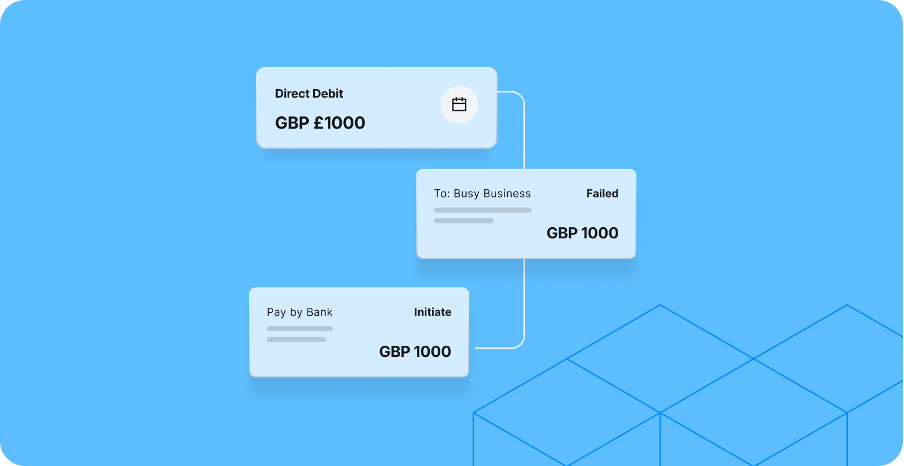
Multi-rail collections does not mean abandoning Direct Debit. It means building it into a hierarchy of options so that when it fails, an alternative is triggered based on the ARUDD reason code rather than escalated to a manual queue. This gives lenders the ability to configure and manage their own recovery logic directly, adapting it as their portfolio changes, without implementation projects or third-party dependencies.
For recoverable failures such as insufficient funds, a Pay By Bank request can be sent immediately. Where VRP (Bank on File) is in place, a binary funds-available check can be performed before initiating, a yes/no indicator that a payment is likely to succeed, not a balance figure. For a more structured recurring consent, Sweeping Variable Recurring Payments (Sweeping VRP) settles in real time via Faster Payments rather than on the Bacs three-day cycle. Sweeping VRP is live and for certain lending use cases, is the eligible form of VRP for lenders today.
Commercial VRP, the broader form of VRP covering a wider range of use cases, launched in Q1 2026 as part of the UK Payments Initiative (UKPI). Financial services payments, including mortgage payments, are a listed Wave 1 use case. The expansion of the scheme to further use cases is expected later in 2026.
When an alternative route is triggered automatically on a classified failure, the manual triage queue shrinks. Arrears and collections teams shift focus from reason-code classification to genuine hardship cases, and settlement via Faster Payments lands in real time rather than at the end of a five-day batch cycle.
For Finance Directors, the benefit runs deeper than collections performance. Under IFRS 9, provisioning requirements are tied directly to how long an account sits unresolved. Compress that window from days to hours and fewer accounts reach the 30-day Significant Increase in Credit Risk threshold. Lower provisioning exposure, improved capital efficiency, and more predictable month-end cash positions follow.
Explore Modulr's Pay-ins and Pay-outs solutions.
This article is for informational purposes only and should not be construed as financial, legal, or regulatory advice.
TL;DR
Direct Debit failure rates are rising, and ARUDD information is visible at day four. The cycle from collection start to actionable information is four days, not three. The cost has three layers: transaction costs on re-presentation, agent time on triage, and arrears aging under IFRS 9 provisioning requirements. Concentrating collections on a single batch rail means every one of these problems resolves on the same slow timeline.
Sweeping Variable Recurring Payments (Sweeping VRP) is live and lending-eligible today. Commercial VRP launched in Q1 2026, with loan repayments a listed use case. To explore how Modulr's platform supports Direct Debit Pay-ins, Open Banking, and Faster Payments Pay-outs, read how lenders can drive growth and efficiency with Modulr or explore how the new lending stack reshapes the borrower experience. Or talk to us directly about your collections set up.
FAQs
What is the average Direct Debit failure rate in the UK?
As at end of March 2026, ONS data shows the Direct Debit failure rate for loans stood at 5.41%, up from 4.49% previously, a rise of more than 20%. For lenders with borrowers in or near arrears, the effective failure rate is typically materially higher.
What happens when a Direct Debit collection fails?
When a Direct Debit fails, Bacs returns the transaction on T+1 or T+2. ARUDD reporting, which confirms the failure and its reason code, becomes visible to the lender on day four of the collection cycle. From that point, the lender can re-present, contact the borrower, or trigger an alternative collection route.
What is multi-rail collections?
Multi-rail collections means building Direct Debit into a hierarchy of payment options so that when it fails, an alternative route (such as Pay By Bank or Bank on File) is triggered automatically rather than manually, reducing the time between failure and recovery from days to hours.
How does multi-rail collections affect IFRS 9 provisioning?
By compressing the time between a failed collection and its resolution, multi-rail infrastructure reduces the number of accounts that remain unresolved beyond the 30-day window that statistically increases default risk and triggers higher provisioning requirements under IFRS 9.
What are the operational costs of manual Direct Debit retry processes?
Industry benchmarks suggest each manual retry cycle consumes between 12 and 18 minutes of agent time when logged, queued, and actioned. For a lender processing 10,000 collections per month at a 5.41% failure rate, that is between 108 and 163 hours of agent time per month, before a single recovery call is made.
